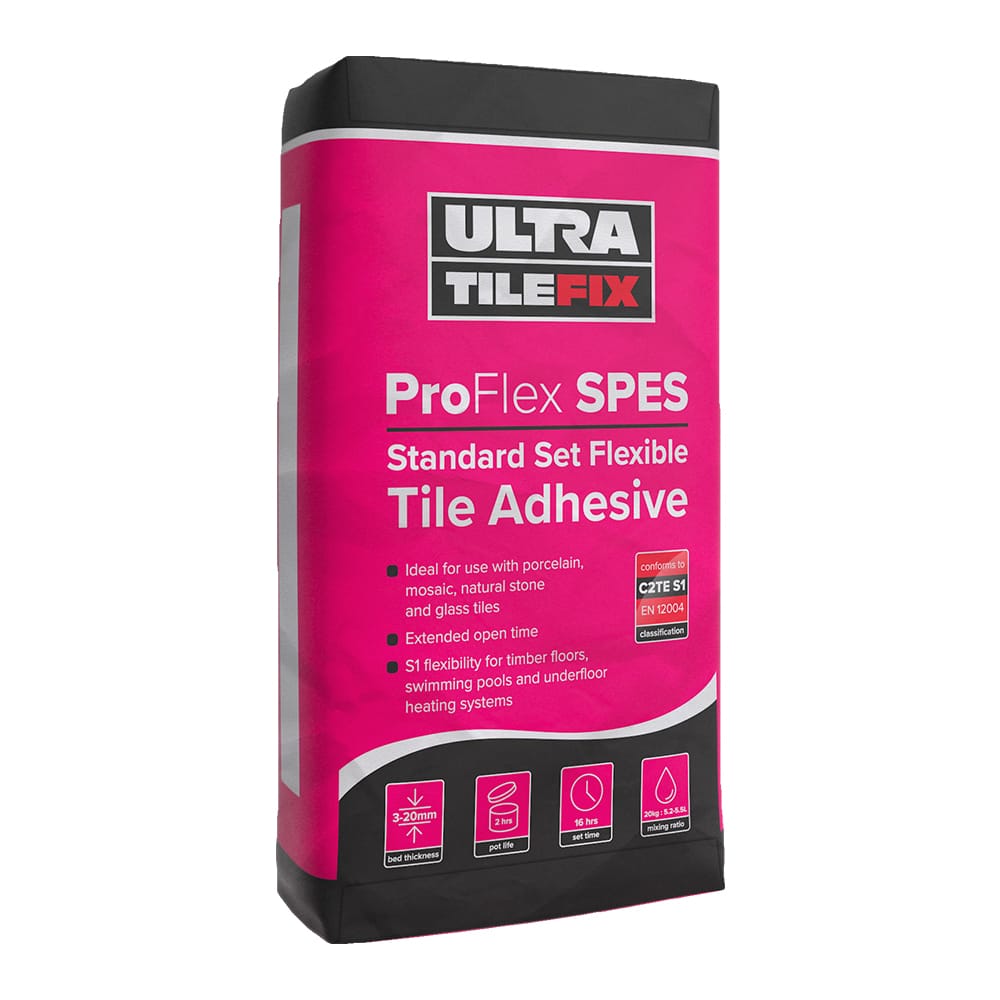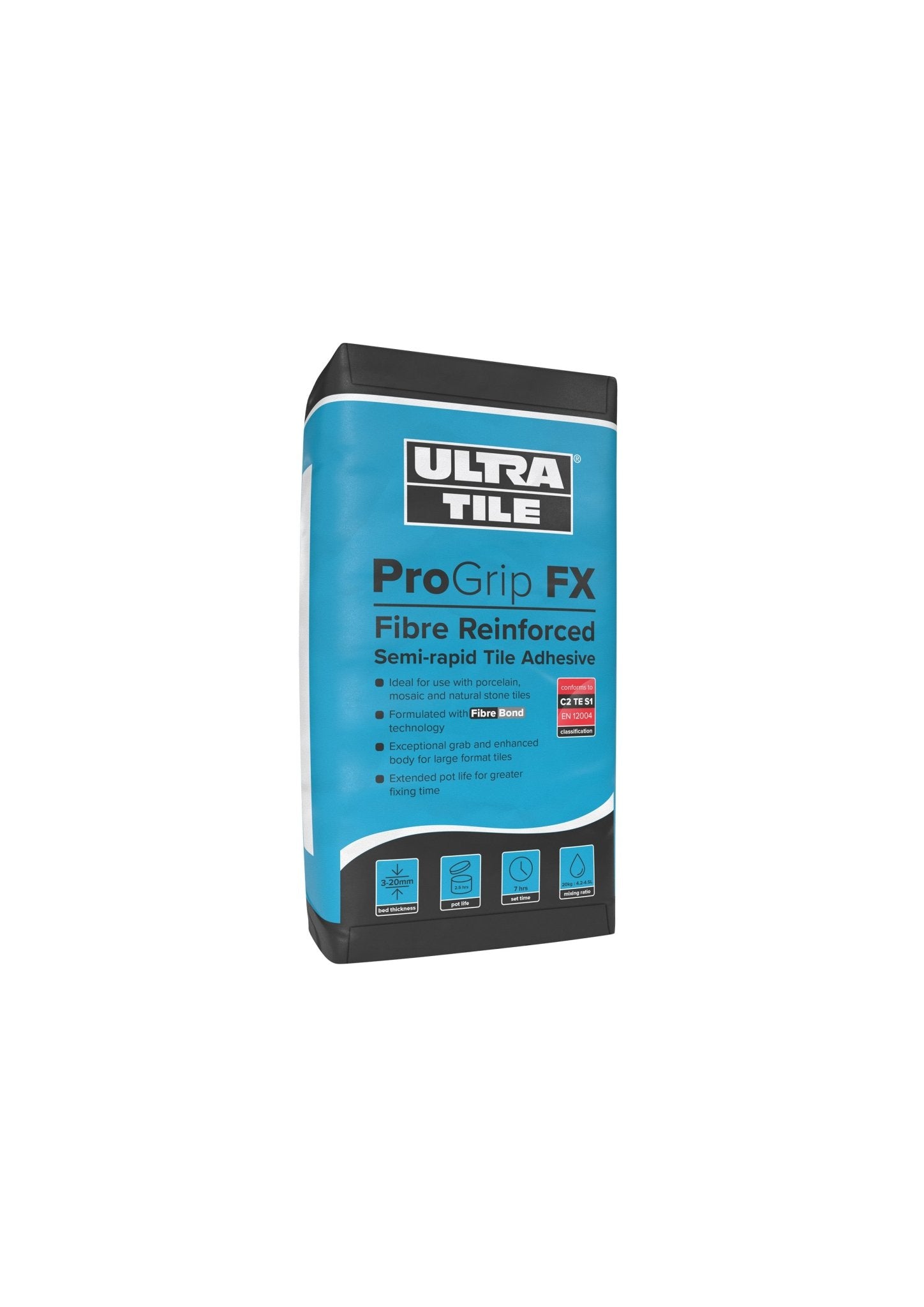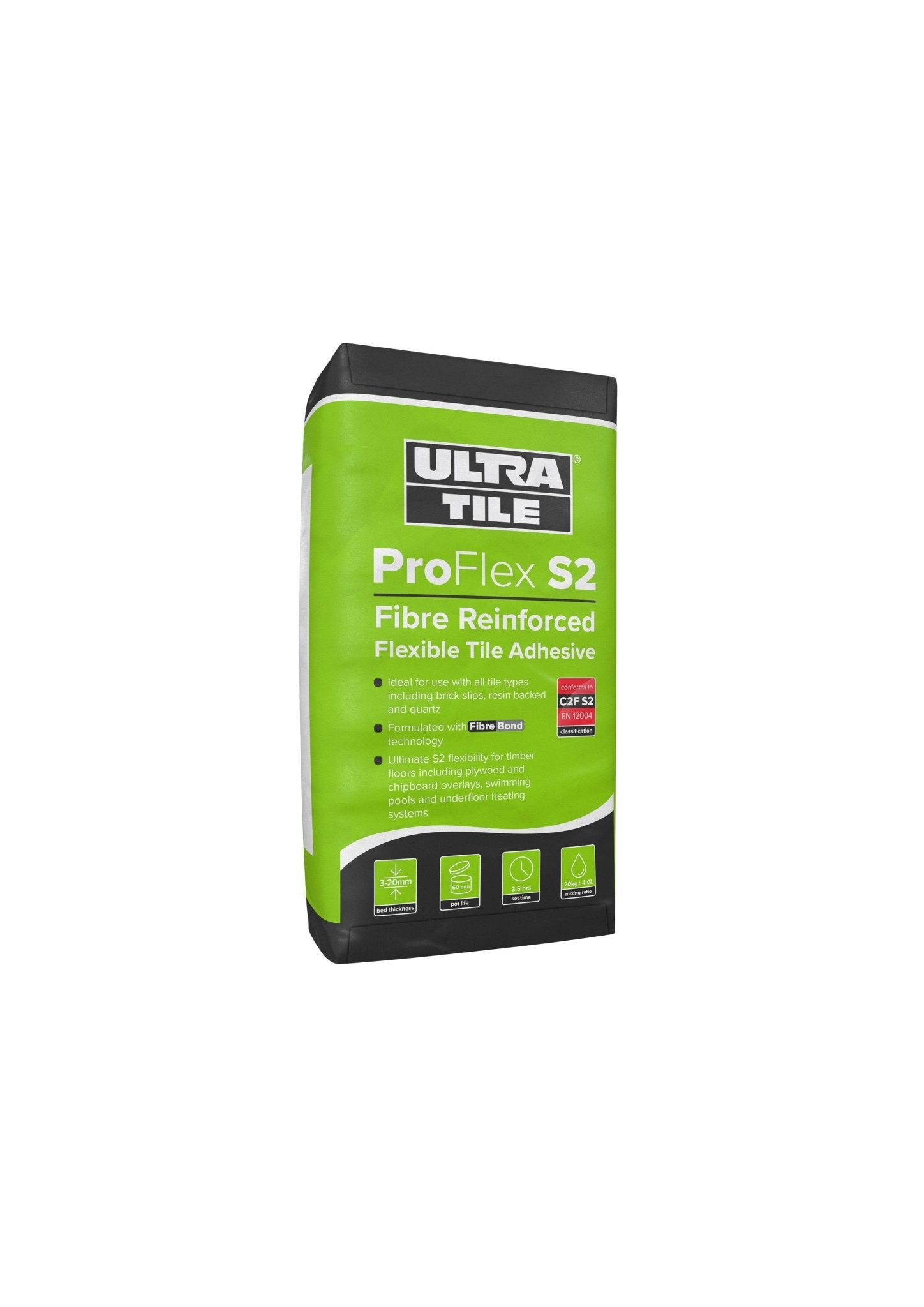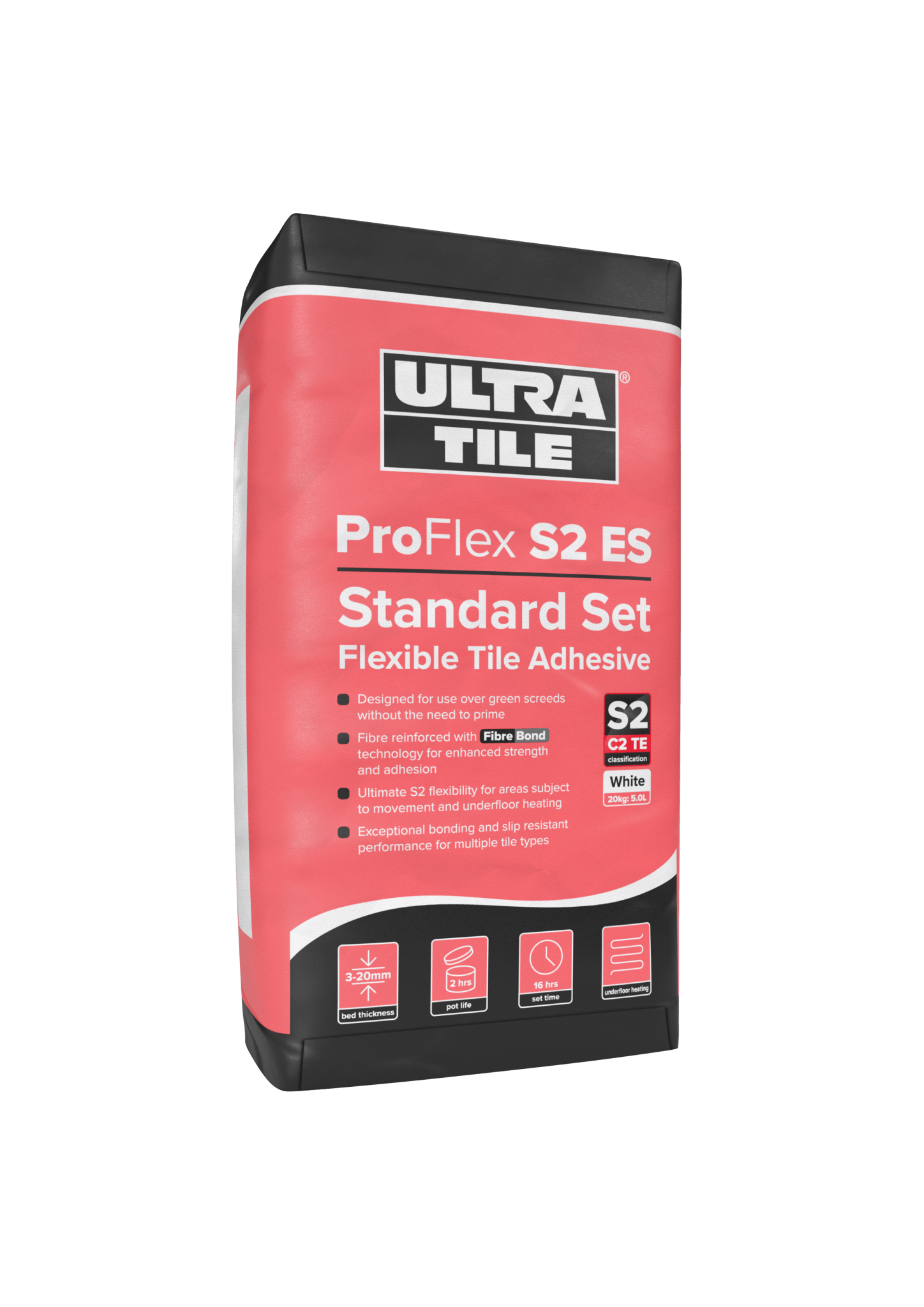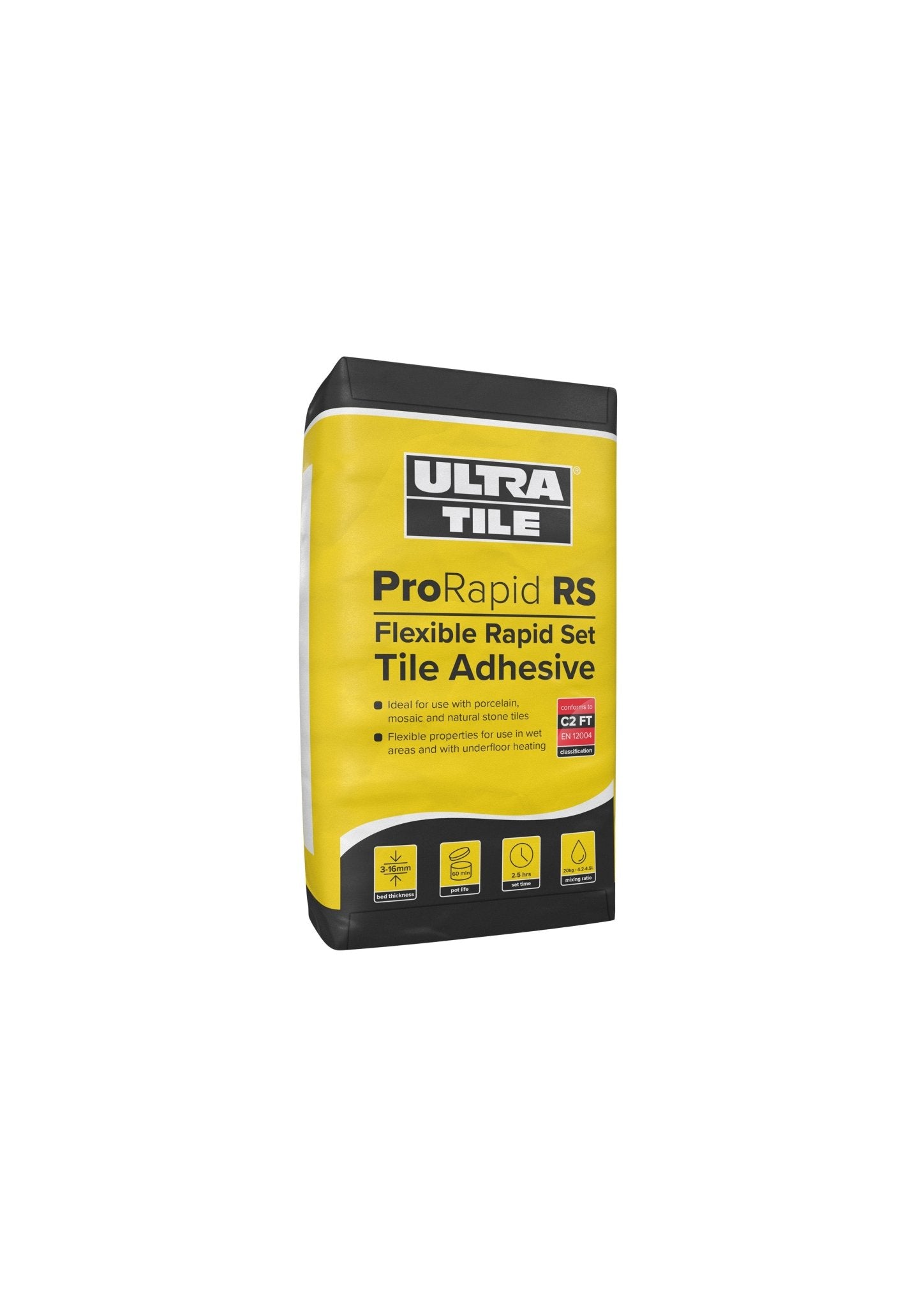
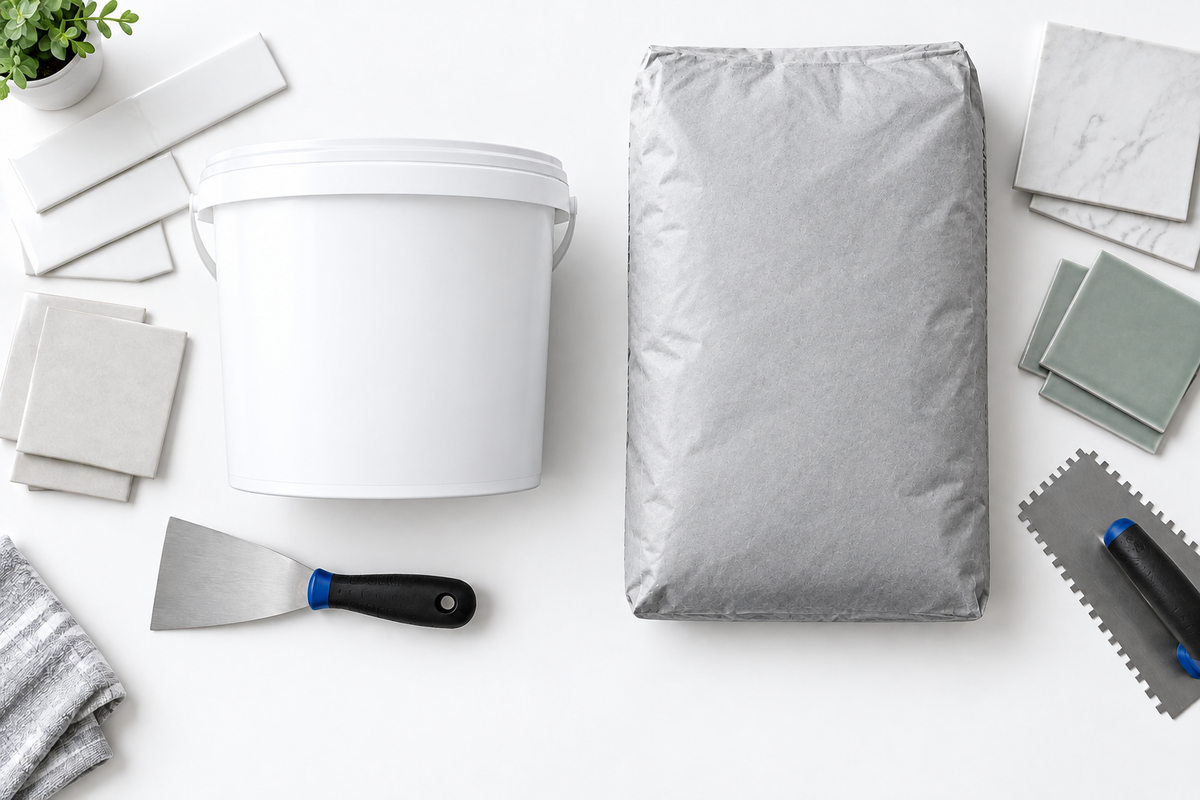
Ready-mixed tile adhesive comes in a tub, sets as its water evaporates, and suits small ceramic wall tiles in dry or lightly splashed areas. Powdered tile adhesive comes in a bag, sets through a chemical reaction once you add water, and suits almost everything else: floors, porcelain, large-format tiles, showers, wet rooms, outdoor patios and underfloor heating. If your tile is porcelain, larger than about 300 x 300 mm, going on a floor or getting wet every day, you need a powdered adhesive.
The adhesive costs a fraction of what you spend on tiles, yet it decides whether those tiles stay on the wall for 20 years or crack and drop within two. This guide explains how each type works, which of our tiles suit each one, and how to mix and spread adhesive the way a professional tiler does.
How each adhesive sets, and why it matters
Ready-mixed adhesive: it dries
A ready-mixed adhesive is an acrylic or vinyl dispersion, a paste of polymer resin, fillers and water. It grips the tile once the water leaves the paste, and the water can only leave in two ways: into the back of the tile or into the wall. A wall tile with an absorbent ceramic body draws that water out, so the adhesive dries and hardens behind it within 24 to 48 hours.
Porcelain changes the picture. BS EN 14411 classes porcelain as group BIa, which means it absorbs 0.5% of its weight in water or less. Water cannot escape into a porcelain tile, so ready-mixed adhesive behind it dries only from the edges inwards. Behind a large tile, the centre can stay soft for weeks. The same problem occurs on a floor, where the substrate below is rarely absorbent enough and foot traffic flexes the tile before the bond has formed.
Water also works in reverse. Most dispersion adhesives soften again if they stay wet for long periods, which is why most manufacturers exclude power shower areas, wet rooms and swimming pools from their ready-mixed ranges.
Powdered adhesive: it cures
A powdered adhesive is a blend of cement, graded sand and polymer additives. When you add water, the cement hydrates and forms crystals that lock into the back of the tile and the surface of the wall. This reaction does not need air, so the adhesive cures fully behind dense porcelain, behind tiles as large as 1200 x 600 mm and under a floor. Once cured, it does not soften when wet.
The polymers in modern powdered adhesives add grip and flexibility. They allow the adhesive to absorb small movements from timber floors, plasterboard and heated screeds that would crack a rigid bed.
What the codes on the bag or tub mean
Every tile adhesive sold in the UK should carry a classification under BS EN 12004. Reading it tells you more than any marketing claim on the front of the pack.
| Code | Meaning | What it tells you |
| D1 | Dispersion (ready-mixed), normal | Basic wall use in dry areas |
| D2 | Dispersion (ready-mixed), improved | Higher grip, some products allow occasional splashing |
| C1 | Cementitious (powdered), normal | Tensile adhesion of at least 0.5 N/mm², suitable for smaller ceramic tiles on rigid backgrounds |
| C2 | Cementitious (powdered), improved | Tensile adhesion of at least 1.0 N/mm², the right starting point for porcelain, floors and wet areas |
| F | Fast setting | Ready to grout in around 2 to 3 hours |
| T | Reduced slip | Holds wall tiles in place without slipping down the wall |
| E | Extended open time | Gives you longer to place tiles after spreading |
| S1 | Deformable | Transverse deformation of 2.5 mm to less than 5 mm, for timber floors, plasterboard and underfloor heating |
| S2 | Highly deformable | Transverse deformation of 5 mm or more, for high-movement backgrounds |
A bag marked C2 TE S1, for example, is an improved cement-based adhesive that resists slip, gives extended working time and flexes with the background. That combination covers the majority of domestic bathroom and kitchen jobs. Our guide on when to use flexible tile adhesive explains S1 and S2 in more detail.
Ready-mixed vs powdered: side by side
| Factor | Ready-mixed (tub) | Powdered (bag) |
| How it sets | Dries as water evaporates | Cures by chemical reaction |
| Tile types | Ceramic wall tiles, mosaics on mesh | Ceramic, porcelain, natural stone, glass mosaic |
| Tile size | Small to medium, typically up to 300 x 300 mm (check the tub) | Any size, including 600 x 1200 mm with the right grade |
| Walls | Yes | Yes |
| Floors | No | Yes |
| Shower walls and wet rooms | Generally no | Yes, with a tanking system behind |
| Outdoor patios | No | Yes, with an exterior-rated grade |
| Underfloor heating | No | Yes, with an S1 flexible grade |
| Gypsum plaster walls | Yes, no primer needed | es, after priming the plaster |
| Time before grouting | 24 to 48 hours, longer for dense tiles | 2 to 3 hours (rapid set) or around 24 hours (standard set) |
| Mixing | None | Paddle mixer, bucket and clean water |
| Working time once open | Hours, reseal the tub to keep it | 30 minutes to around 4 hours, depending on grade |
| Cost per square metre | Higher | Lower, especially on larger areas |
| Best for | A splashback or a few rows of ceramic tiles above a basin | Bathrooms, shower enclosures, kitchens, floors, hallways, patios |
The gypsum plaster row catches many people out. Cement-based adhesive reacts with gypsum to form a weak layer of ettringite crystals at the joint, so the tiles can lift off with the skim. Prime fresh or skimmed plaster with a suitable primer before you use a powdered adhesive, and allow new plaster at least four weeks to dry. Ready-mixed adhesive does not react with gypsum, which is one reason it remains popular for splashbacks on skimmed walls.
Which adhesive for your project: a room-by-room guide
Here is how we advise customers in our Bridgend showroom, using tiles from our own range as examples.
Kitchen splashback behind a hob or sink
A few rows of glossy ceramic, such as our Torino Grey 30x45cm gloss wall tile or the Aurora 15x30cm glossy wall tiles, suit a good D2 ready-mixed adhesive. The area sees splashes rather than running water, the tiles are absorbent and the job is small enough that mixing a whole bag makes little sense. Behind a hob, check the tub's heat rating, or use a powdered adhesive for peace of mind.
Bathroom walls outside the shower
For ceramic wall tiles like the 2che 20x60cm range or Modus 20x60cm matt wall tiles on walls away from direct water, either type works. We lean towards a powdered C2 adhesive for a full bathroom because it costs less across 10 to 15 square metres and leaves no doubt about steam and condensation. That point matters in South Wales, where damp air and long wet winters keep bathroom walls humid for much of the year.
Shower enclosures, walk-in showers and wet rooms
Use a powdered C2 adhesive, with an S1 flexible grade on plasterboard or tile backer board, over a full tanking system. Shower walls get soaked twice a day for years, and this is exactly where ready-mixed adhesive fails first. If you prefer a grout-free shower, our shower panels fix with their own panel adhesive and avoid tile adhesive entirely.
Bathroom, kitchen and hallway floors
Every floor needs a powdered adhesive. Porcelain floor tiles such as Parquet Light 60x60 matt wood-effect porcelain or Mexico Blue 20x20 matt porcelain absorb almost no water, so only a cement-based bed will cure beneath them. On a timber floor, overboard with tile backer board and use an S1 flexible adhesive. On a sound concrete slab, a C2 adhesive works. For the full picture on entrance floors, see our guide to hallway floor tiles.
Large-format porcelain
Tiles such as Gemini Onyx 60x120cm polished porcelain from our walls and floors range need a powdered C2 S1 adhesive, ideally a grade made for large formats. Back-butter each tile with a thin coat as well as combing adhesive onto the wall or floor, so you achieve a solid bed with no hollow spots. On walls, check the background's weight limit first. Plasterboard is commonly limited to 32 kg per square metre including adhesive and grout, and 10 mm porcelain alone weighs around 22 to 24 kg per square metre.
Underfloor heating
Tiles over electric underfloor heating expand and contract every time the system warms and cools. Use a powdered S1 flexible adhesive, embed the heating mat fully, and keep the system switched off until the adhesive and grout have cured for the time stated on the bag.
Outdoor patios
Our O20 Patio Chateau Beige 60x90 2cm porcelain and the rest of our outdoor patio tiles face rain, frost and summer heat. Lay them on a full bed of exterior-rated mortar or adhesive, and apply a bonding primer or slurry to the back of each tile. Ready-mixed adhesive has no place outdoors.
How to mix and spread powdered adhesive like a professional
Most tile failures we see come from how the adhesive went on, rather than which adhesive was chosen. Follow these steps for a bond that lasts.
- Prepare the background. It should be clean, dry, flat and sound. Remove loose paint, prime plaster and dusty screeds, and fill hollows before you start rather than trying to correct them with extra adhesive.
- Measure the water. Pour the quantity printed on the bag into a clean bucket first, then add the powder. Adding water to powder creates dry lumps at the bottom.
- Mix with a paddle. Use a drill and paddle at low speed for around two to three minutes until smooth, let it stand for the time on the bag (often three to five minutes), then remix briefly. Never add more water later to loosen a mix that has started to stiffen.
- Comb it out with the right notch. Spread a thin, firm key coat with the flat edge of the trowel, then comb ridges in one direction with the notched edge.
- Bed the tiles. Press and slide each tile across the ridges so they collapse into a solid layer. Lift a tile every few square metres to check coverage. Walls in wet areas and every floor need a solid bed with no voids, as BS 5385 requires.
- Work within the open time. Spread only as much as you can tile in 15 to 20 minutes. If a finger touch leaves no adhesive on your skin, scrape it off and spread fresh.
- Respect the temperature. Mix and tile between 5°C and 25°C. In an unheated extension or garage in a Welsh winter, cure times can double.
Never spot-fix tiles with five dabs of adhesive. Water collects in the voids, the tile cracks under load, and BS 5385 does not permit the method.
Which trowel and how much adhesive
| Tile size | Typical trowel notch | Approximate adhesive per m² |
| Mosaics and tiles up to 150 x 150 mm | 4 to 6 mm | 2 to 3 kg |
| 200 x 200 mm to 300 x 600 mm wall tiles | 6 to 10 mm | 3 to 4.5 kg |
| 600 x 600 mm floor tiles | 10 to 12 mm, plus back-buttering | 5 to 6 kg |
| 600 x 1200 mm and larger | 12 mm or a slant-notch trowel, plus back-buttering | 6 to 7 kg |
These figures are typical. Always check the coverage chart on the bag you buy.
As a worked example, a family bathroom with 12 square metres of 30 x 60 cm ceramic wall tiles at around 4 kg per square metre needs 48 kg of adhesive, which is three 20 kg bags with a small reserve. Add a 4 square metre floor of 60 x 60 cm porcelain at around 5.5 kg per square metre, and you need a further 22 kg, so one more bag plus a margin. Bring your measurements to the showroom and we will check the numbers with you. Our tiling tools, spacers and levellers and grouts and silicones complete the kit.
Common mistakes to avoid
- Using ready-mixed adhesive behind porcelain. The adhesive cannot dry, and the tiles slide or sound hollow weeks later.
- Using ready-mixed adhesive inside a shower. Daily soaking softens the bond, and tiles start to drop within a year or two.
- Putting powdered adhesive straight onto unprimed gypsum plaster. The ettringite reaction weakens the joint and the tiles can pull the skim away with them.
- Re-tempering a stiffening mix with extra water. It weakens the cured bed. Mix smaller batches instead.
- Choosing the bag on price alone. A C1 adhesive on a timber floor or heated screed will crack. Read the classification code.
- Grouting too early. Grout locks moisture into ready-mixed adhesive and slows curing further. Wait the full time on the pack.
For the trade
For fitters and tilers, the standard specification across most domestic work is a C2 TE S1 powdered adhesive, with a rapid-set grade when you need to grout and hand over the same day. Keep a tub of D2 ready-mixed in the van for small ceramic repairs and splashbacks on skimmed walls. A Bridgend Tiles & Bathrooms trade account gives you trade pricing on tiling essentials and local collection from Brackla.
Frequently asked questions
Can I use ready-mixed tile adhesive on porcelain tiles?
We do not recommend it. Porcelain absorbs 0.5% of its weight in water or less, so ready-mixed adhesive has no way to dry behind it, especially on larger tiles. Use a powdered C2 adhesive, which cures by chemical reaction and bonds fully behind dense porcelain.
Is ready-mixed tile adhesive waterproof?
Ready-mixed adhesive resists occasional splashes once dry, but most products soften if they stay wet for long periods. That rules them out for shower walls, wet rooms and floors. Some D2 products allow use in areas with intermittent wetting, so always check the tub before you buy.
Which adhesive should I use on plasterboard in a bathroom?
Use a powdered C2 S1 flexible adhesive on plasterboard in a bathroom, and keep the total tile weight within the board's limit, commonly 32 kg per square metre including adhesive and grout. Inside a shower, fit a tanking system or tile backer board rather than tiling straight onto standard plasterboard.
How long should I wait before grouting?
Rapid-set powdered adhesives are usually ready to grout in two to three hours. Standard-set powdered adhesives need around 24 hours. Ready-mixed adhesives need at least 24 to 48 hours, and longer behind dense or large tiles. Always follow the time printed on the pack.
How much tile adhesive do I need?
As a guide, allow 3 to 4.5 kg per square metre for standard wall tiles and 5 to 7 kg for large floor tiles, depending on the trowel notch. Measure each wall and floor in square metres, multiply by the coverage on the bag, and add around 10% for wastage.
Talk to us before you tile
The right adhesive depends on your tile, your wall or floor and how the room is used. Bring photos of the space and your tile choice to our Bridgend showroom, and our team will recommend the adhesive, primer, grout and tools for the job, along with the quantities you need.
Visit us at Unit 1, Main Avenue, Brackla Industrial Estate, Bridgend, CF31 2BB. We are open Monday to Friday from 8am to 5pm and Saturday from 10am to 2pm. Call 01656 767740, browse our tiles and tiling essentials online, or plan your visit.