If you've been putting together a materials list for a bathroom, wet room, or kitchen retile, you've likely come across terms like "Decoupling Membrane" or "Decoupling Mat" and "cement backer board" and wondered whether they're two ways of describing the same thing, or optional extras. They're neither. They do two completely different jobs, and on most wet area projects, you actually need both — just in different places, doing different things.
We spend a lot of time helping customers and trade buyers work out exactly what's going under the tile before they buy it, because getting this layer wrong is the single most common cause of jobs going wrong later. This guide is designed to give you a proper foundation for that decision, whatever the project.
The short version
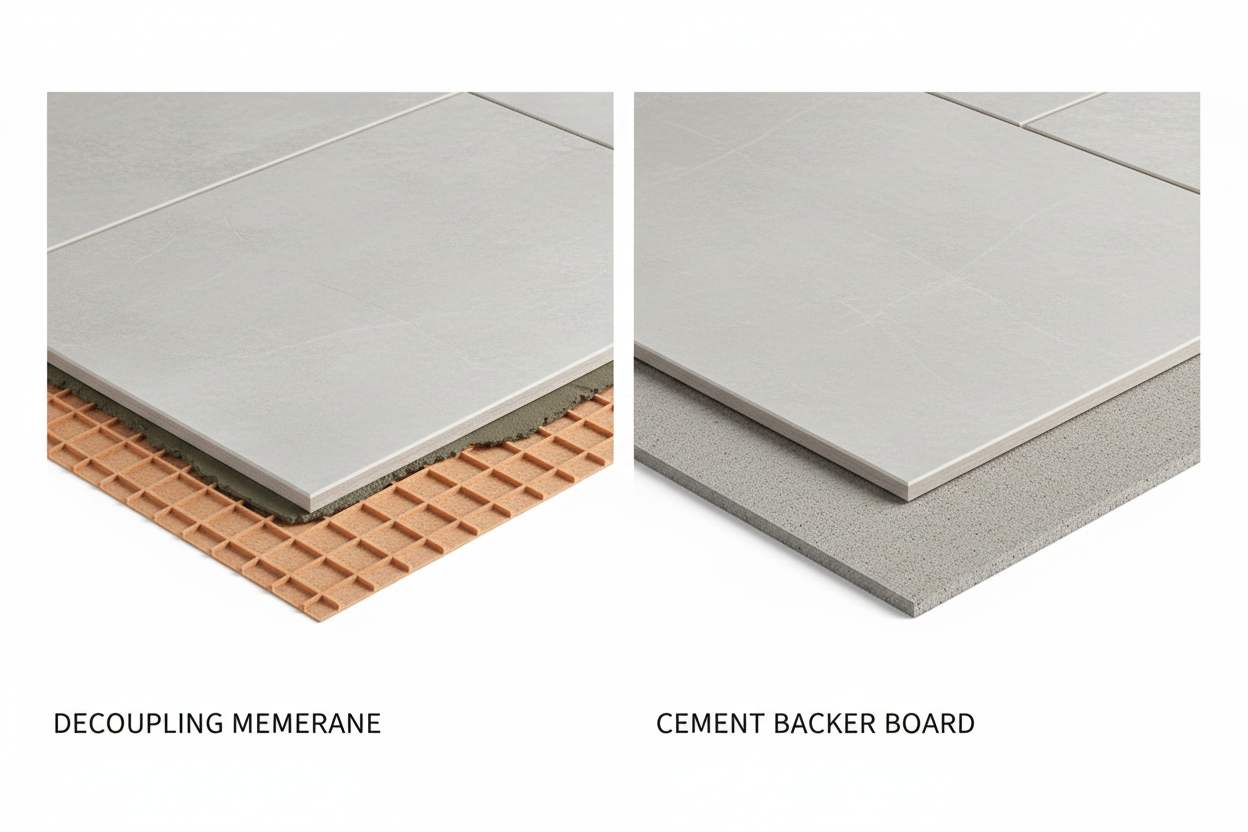
- Cement backer board gives tiles something solid, flat, and moisture-tolerant to sit on. It upgrades the wall or floor itself.
- Decoupling membrane stops movement in the structure underneath — a slight settle in a concrete floor, seasonal timber movement, thermal cycling from underfloor heating — from cracking tiles or grout lines above it.
One is about what the tiles are fixed to. The other is about stopping what's happening underneath from reaching the tiles at all. Neither one waterproofs a wet area on its own, and neither one fixes a genuinely unstable floor — that's a structural question that needs answering before any board or membrane goes down, and it's always worth raising with a builder or tradesperson if you're in any doubt.
Cement backer board: the stable base layer
Cement backer board — you'll see this stocked under names like Marmox Multiboard, Wedi Board, No More Ply, or traditional cement particle boards such as Knauf Aquapanel — is a rigid panel fixed over timber studwork or an existing subfloor. Unlike plasterboard or standard plywood, it won't swell, rot, or lose strength when damp, which is exactly why it's the standard base for anywhere that gets regularly wet.
Where it's the right call:
Shower and bath surrounds. A rigid board on stud walls, ahead of any waterproofing, gives a dead-flat, solid surface that won't move or flex under load and won't degrade from years of splashback and steam.
Floors over timber joists, particularly under large-format tiles or natural stone, which need a stiffer, flatter base than standard flooring ply provides on its own.
Kitchen splashbacks near hobs, where a non-combustible, rigid board is the safer, longer-lasting choice over plasterboard.
What it doesn't do: it's easy to assume "cement board" means "waterproof board." It isn't, on its own — it's water-resistant, meaning it survives being wet without falling apart, but water can still pass through it to the structure behind. That's why every wet area needs a separate waterproofing layer (a tanking kit, a liquid-applied membrane, or a foam board system with sealed and taped joints) over the top of the backer board before tiling starts. If you're speccing a job and waterproofing isn't itemised separately from the board, that's worth clarifying before you buy — it isn't automatically included just because backer board is going in.
Decoupling membrane: the movement layer
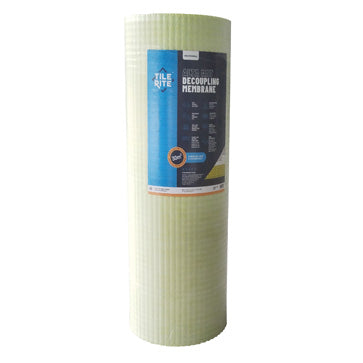
A decoupling membrane — Schluter-Ditra is the name most people recognise, alongside variants like Ditra-Heat for underfloor heating projects — is a thin plastic sheet with a grid of small cavities on the underside. It bonds to the floor, and the tiles bond to it. The grid pattern lets the membrane flex independently, in tiny increments, across its whole surface.
That structure solves three problems that come up constantly in real installations:
Hairline cracking in concrete floors. New concrete slabs keep shrinking and settling for a year or more after they're poured, and older slabs frequently already have minor cracks hidden under the existing floor covering. Without a decoupling layer, that movement travels straight up into grout lines and eventually the tiles themselves. With it, the membrane absorbs the movement before it reaches the surface.
Timber floors that move seasonally. Wood subfloors expand and contract slightly with humidity through the year. Large-format tiles have very little tolerance for this, and skipping a decoupling layer under them is one of the most common root causes of cracked grout lines and lifted tile edges in installations a few years old.
Underfloor heating. Heated floors expand and contract every time they cycle on and off. Some decoupling mats are designed to house the heating cable and uncouple the tile from that thermal movement in one product — it's the standard specification wherever underfloor heating sits directly under tile.
Where it's the right call: primarily floors — over concrete (especially newer pours, or anywhere the slab's history and condition aren't fully known), over timber subfloors under large-format porcelain or natural stone, and as standard practice under any underfloor heating installation.
What it doesn't do: fix a genuinely unstable or bouncy floor. If timber joists are undersized or over-spanning, no membrane compensates for that — it's a structural issue that needs resolving first, ideally by a builder or structural engineer, before any tile board is specified.
Why both often show up on the same job
This is the point that trips up a lot of first-time specifiers: these aren't competing products to choose between. On a typical bathroom or wet room, they usually both appear, doing different jobs in different places:
Walls in the shower or bath area: backer board for rigidity, a waterproofing membrane over the top of that, then tile.
Floor: a decoupling membrane over the subfloor (concrete or timber) to isolate the tile from movement, then tile — with a separate waterproofing/tanking layer added where it's a wet room floor rather than a standard bathroom floor.
Occasionally both appear on the same floor — a layer of backer board where a timber subfloor needs extra stiffening for stone tile, with a decoupling membrane laid over the top of that. Which combination is right depends entirely on the existing structure: what the floor and walls are made of, their condition, and what's going over them. That's exactly the kind of thing worth working through before you buy, rather than after.
A quick reference for common scenarios
| Your situation | Likely spec |
|---|---|
| Shower/bath wall, timber stud construction | Cement backer board + separate waterproofing membrane |
| New or unknown-history concrete floor | Decoupling membrane rated for crack isolation |
| Large-format tile or natural stone over a timber floor | Decoupling membrane, plus backer board if the subfloor needs extra stiffening |
| Underfloor heating going in under tile | Decoupling membrane with integrated heating channels |
| Kitchen splashback, no sustained wet exposure | Cement backer board alone is often sufficient |
| Floor feels bouncy or you're unsure of joist spec | Get the structure checked before speccing any board or membrane |
Speccing a bathroom, wet room, or kitchen retile and want a clear steer on what to buy for your specific walls and floor? Pop into Bridgend Tiles & Bathrooms or get in touch with the showroom team — we'll help you get the foundation right before you commit to a tile.